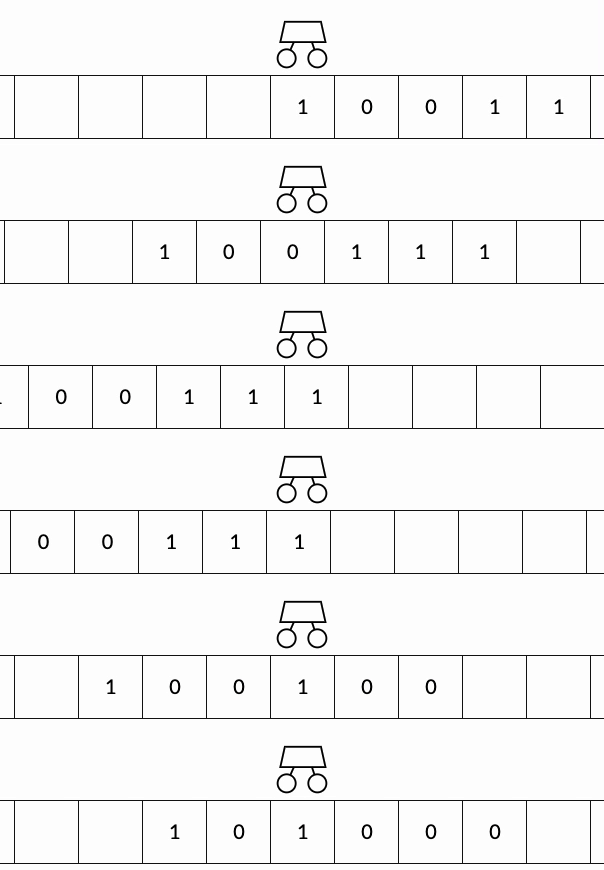
This visualisation shows a Turing Machine with a simple set of rules incrementing 39 to 40 in binary. Source: Medium.
This visualisation shows a Turing Machine with a simple set of rules incrementing 39 to 40 in binary. Source: Medium.
The “computable” numbers may be described briefly as the real numbers whose expressions as a decimal are calculable by finite means. Although the subject of this paper is ostensibly the computable numbers. it is almost equally easy to define and investigate computable functions of an integral variable or a real or computable variable, computable predicates, and so forth. The fundamental problems involved are, however, the same in each case, and I have chosen the computable numbers for explicit treatment as involving the least cumbrous technique. I hope shortly to give an account of the relations of the computable numbers, functions, and so forth to one another. This will include a development of the theory of functions of a real variable expressed in terms of computable numbers. According to my definition, a number is computable if its decimal can be written down by a machine…
Note: This is an example of a Jekyll-based project website template: Github link.
The following content is generated by ChatGPT. The figure is manually added.
The paper “On Computable Numbers, with an Application to the Entscheidungsproblem” was published by Alan Turing in 1936. In this groundbreaking paper, Turing introduced the concept of a universal computing machine, now known as the Turing machine.
Turing’s main objective in this paper was to investigate the notion of computability and its relation to the Entscheidungsproblem (the decision problem), which is concerned with determining whether a given mathematical statement is provable or not.
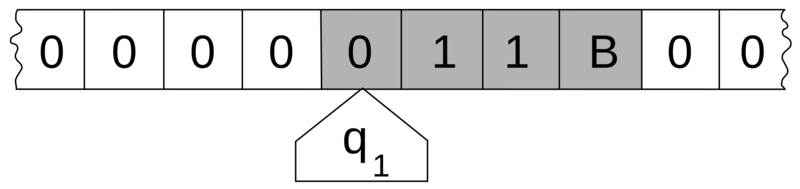
Figure 1: A representation of a Turing Machine. Source: Wiki.
| Computable Numbers | Non-Computable Numbers |
|---|---|
| Rational numbers, e.g., 1/2, 3/4 | Transcendental numbers, e.g., π, e |
| Algebraic numbers, e.g., √2, ∛3 | Non-algebraic numbers, e.g., √2 + √3 |
| Numbers with finite decimal representations | Numbers with infinite, non-repeating decimal representations |
He used the concept of a universal Turing machine to prove that the set of computable functions is recursively enumerable, meaning it can be listed by an algorithm.
Turing’s paper laid the foundation for the theory of computation and had a profound impact on the development of computer science. The Turing machine became a fundamental concept in theoretical computer science, serving as a theoretical model for studying the limits and capabilities of computation. Turing’s work also influenced the development of programming languages, algorithms, and the design of modern computers.
@article{turing1936computable,
  title={On computable numbers, with an application to the Entscheidungsproblem},
  author={Turing, Alan Mathison},
  journal={Journal of Mathematics},
  volume={58},
  number={345-363},
  pages={5},
  year={1936}
}